


Below is information you may find useful:
On this page you can find information that may help you utilize anodic aluminum oxide membranes towards a variety of applications.
Some 3D-printing methods use a liquid resin that hardens on a light-activated process. A consecutive display of cross-sections of a printed model as subsequent layers of a printout of a geometry are created. A building plate is submerged on a photosetting resin in a vat and lowered until creating a thin resin layer between the plate and a fluorinated ethylene propylene (FEP) adhesive film. Illumination of the photosetting resin, using a wavelength in the 405 nm range, hardens the resin material into a set cross-sectional pattern displayed by an LCD screen. LCD screens can block light or allow light to cross through a digital displayed screen showing the cross-sectional part of a modeled geometry. The building plate is raised pulling the harden resin from the FEP film. A sufficient height is reached allowing resin to replenish the gap before a new digital displayed image is imprinted onto the already hardened resin. This method limits the amount of resin used. The resolution of this method can be in the ±0.1 mm range allowing users to create microchannels as small as 500 micrometers in diameter.
Some 3D-printing methods use a thermoplastic filament extruded through a heated nozzle onto a building platform which solidifies as it cools. Just like resin 3D-prinitng methods, a consecutive display of cross-sectional prints of a model shown as subsequent layers of a printout of a geometry are created. Unlike resin printers, the filament 3D-printers rely on heat to fuse consecutive cross-sections of the printed model. The resolution of filament 3D-printer is less than that of the resin 3D-printering methods as filament polymers are often extruded through a 0.4 mm diameter tip.
Milling is the mechanical process of removing material from a stock workpiece using a rotary cutter. A range of tools can be used during the milling processes allowing the user to create a variety of surface features. Modern milling machines use computer numerical control (CNC) capabilities allowing the machine to operate semi-automatically. A computer-aided design (CAD) software allows researcher to create a 3D-model of designed parts. A computer-aided manufacturing (CAM) software creates machine simulations and operations for muti-axis setups on which the CNC mill uses to cut pre-designed parts.
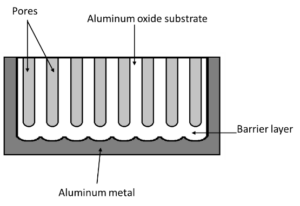
In the last few decades certain methods have allowed researchers to control the anodization of aluminum to produce nano-scale porous features. During anodization, an oxide layer is formed when a metal, like aluminum, is connected to the anode of a power supply and a potential is applied. A reaction occurs while the metal is submerged in an electrolyte. The most common types of electrolytes are sulfuric acid, oxalic acid and phosphoric acid. The applied voltage determines the size of the pores ranging from 5 to 250 nm, were higher potentials increase pore size. Longer applied currents generate thicker oxide layers.
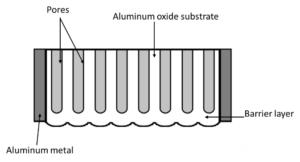
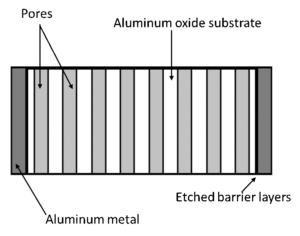
Prolonged anodization promotes the formation of pores in a hexagonally ordered array. This creates a pattern for which a consecutive anodization can take place to create well organized and uniformed pore structures. At the base of the pore an oxide barrier is formed closing the pore, similar to a test tube. Etching of the aluminum metal and subsequently the oxide barrier layer opens the pores creating a nano-porous substrate.
Adipiscing lacus ut elementum, nec duis, tempor litora turpis dapibus. Imperdiet cursus odio tortor in elementum. Egestas nunc eleifend feugiat lectus laoreet, vel nunc taciti integer cras. Hac pede dis, praesent nibh ac dui mauris sit. A nullam ut, tempus nulla. Rutrum orci sit commodo vivamus quam adipiscing, ullamcorper magna donec integer eget mauris quisque.
Adipiscing lacus ut elementum, nec duis, tempor litora turpis dapibus. Imperdiet cursus odio tortor in elementum. Egestas nunc eleifend feugiat lectus laoreet, vel nunc taciti integer cras. Hac pede dis, praesent nibh ac dui mauris sit. A nullam ut, tempus nulla. Rutrum orci sit commodo vivamus quam adipiscing, ullamcorper magna donec integer eget mauris quisque.
Adipiscing lacus ut elementum, nec duis, tempor litora turpis dapibus. Imperdiet cursus odio tortor in elementum. Egestas nunc eleifend feugiat lectus laoreet, vel nunc taciti integer cras. Hac pede dis, praesent nibh ac dui mauris sit. A nullam ut, tempus nulla. Rutrum orci sit commodo vivamus quam adipiscing, ullamcorper magna donec integer eget mauris quisque.

